Is Hardox 450 Really Worth It for Excavator Buckets in Mining Applications?
30 Jan, 2026Company
In our workshop, Hardox 450 is not just a material; it is the backbone of our heavy-duty mining buckets. With over 20 years of OEM manufacturing experience for international mining brands, we repeatedly hear the same question from procurement teams: "Can I save costs by simply using thicker regular steel?"Our answer, backed by two decades of field data, is a firm No. Here is the engineering reality behind that decision.
Hardox 450 vs. Regular Steel: A Metallurgical Perspective
Regular structural steel (like Q355B or ASTM A36) relies on sheer mass for resistance. However, it lacks the refined grain structure achieved through SSAB’s precise quenching and tempering process.
While regular steel has a Brinell hardness of around 150 HBW, Hardox 450 offers a nominal hardness of 450 HBW. But the real expert advantage is the yield strength: Hardox 450 reaches approximately 1200 MPa, nearly three times that of standard structural steel at around 355 MPa. This allows the bucket to deform elastically under extreme impact without permanent buckling or structural failure.
Engineering Specification: At-a-Glance Comparison (Based on OEM Field Applications)
Technical Property
Mild Steel (e.g., Q355B / A36)
Hardox 450 (Wear Plate)
Engineering Impact
Brinell Hardness
~150 HBW
425 - 475 HBW
Hardox offers 3x to 4x the sliding wear resistance.
Yield Strength
≈355 MPa
≈1200 MPa
Higher resistance to permanent deformation under impact.
Impact Toughness
Moderate
High (27 J at −40°C)
Prevents brittle cracking in sub-zero mining environments.
Weight Efficiency
Baseline (100%)
~75% - 80%
Reduces parasitic load on excavator hydraulics.
Typical Application
Top-soil / Light duty
Granite, Iron Ore, Demolition
Critical for high-abrasion and high-impact cycles.
Critical Technical Note: The "Softening" Risk
A common pitfall we see in the market is improper fabrication. Hardox 450's properties are heat-sensitive. If a manufacturer treats it like regular steel—using excessive heat without monitoring the Heat Affected Zone (HAZ)—the steel will undergo "localized softening," dropping from 450 HBW to as low as 250 HBW.
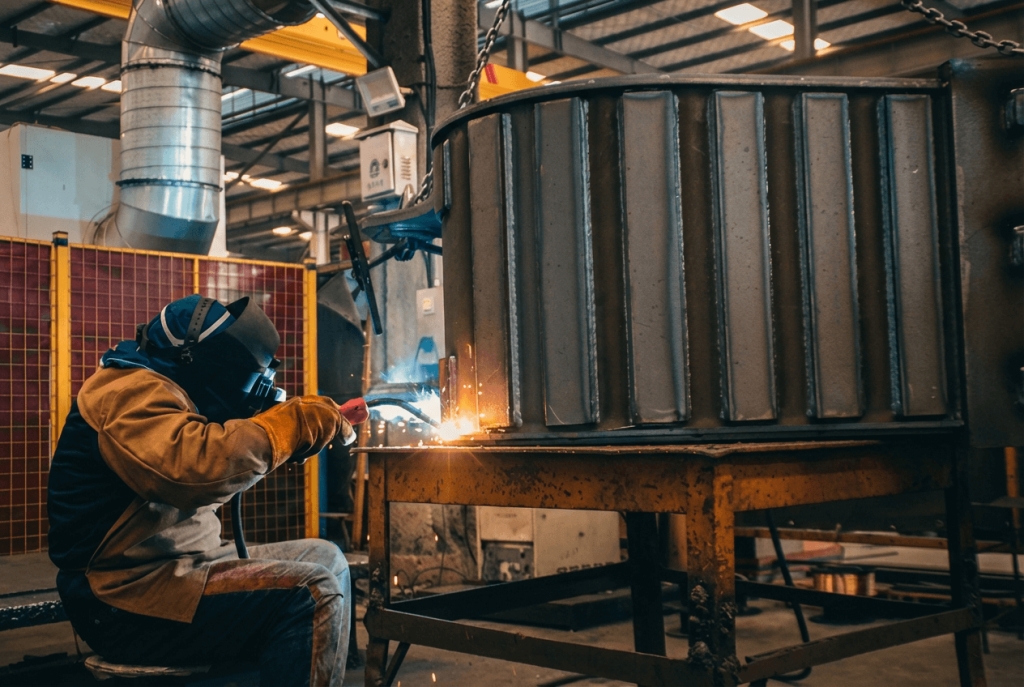
In our factory, our welding engineers strictly control interpass temperature (kept below 225°C) and specify low-hydrogen welding consumables in every documented WPS.We ensure the bucket isn't just "made of Hardox," but that it stays Hardox throughout its service life.
FAQ: Expert Insights for Procurement Managers
Q: How can I verify if my bucket is genuine Hardox 450?
A: Authenticity is traceable. Every genuine plate comes with a unique heat number and serial number inkjet-printed on the surface. We provide a Mill Test Certificate (MTC) with every batch, allowing you to trace the steel back to the specific melt at the Swedish mill.
Q: Can I replace a 25mm mild steel plate with a thinner Hardox 450 plate?
A: Yes. In most mining applications, a 15mm or 16mm Hardox 450 plate can replace 25mm mild steel. This "down-gauging" reduces the bucket weight by roughly 20%, significantly lowering the strain on your excavator’s hydraulics.
Q: Is Hardox 450 suitable for all parts of the bucket?
A: Hardox 450 is ideal for the shell and side cutters. For extreme-wear areas like the leading cutting edge, we often recommend upgrading to Hardox 500 or 600 for maximum longevity.
Why Our Hardox 450 Recommendations Are Based on Production Data
Our position on Hardox 450 is not based on brochures or material datasheets alone.
It is based on 20 years of OEM manufacturing experience, during which our engineers have:
Fabricated hundreds of mining buckets operating in granite, iron ore, and high-abrasion environments
Compared wear life and structural behavior across multiple steel grades, thicknesses, and welding procedures
Conducted repeated failure analysis on returned or cracked buckets to identify the real root causes, not just visible damage
In our workshop, every Hardox 450 plate is tracked by heat number and Mill Test Certificate (MTC), and every welding procedure is defined by a documented WPS, not operator habit.
This allows us to evaluate Hardox 450 not as a “premium label,” but as an engineering decision—balancing wear life, structural stability, bucket weight, welding reliability, and long-term total cost of ownership.
When we say Hardox 450 is worth it, we are not repeating a specification. We are reporting what survives — and what fails — after thousands of operating hours in real mining sites.