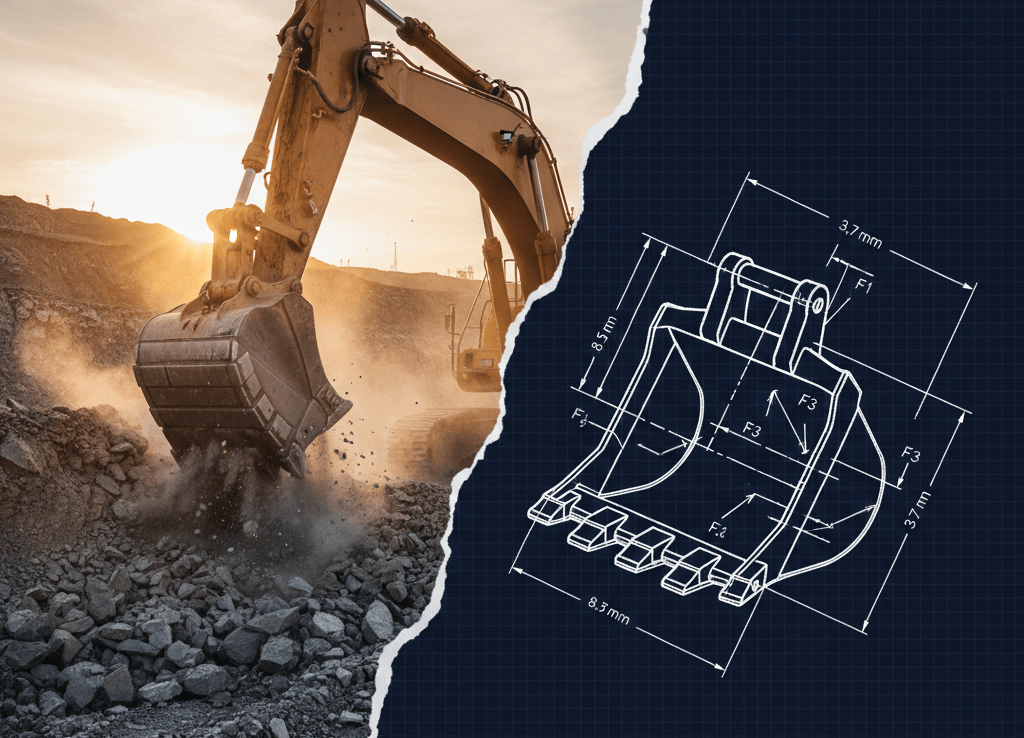
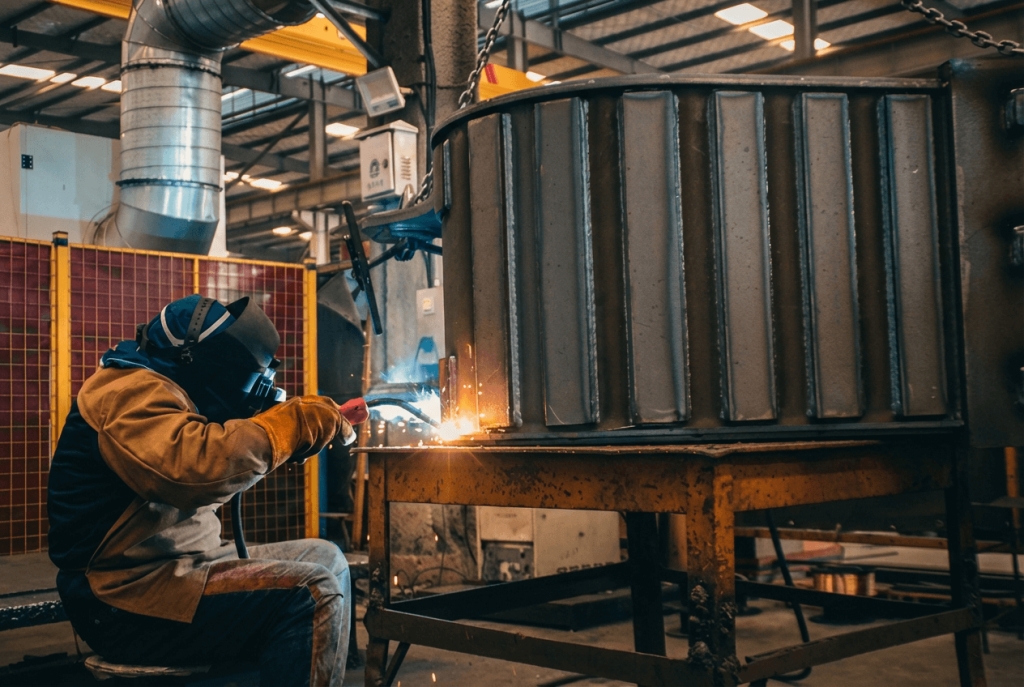
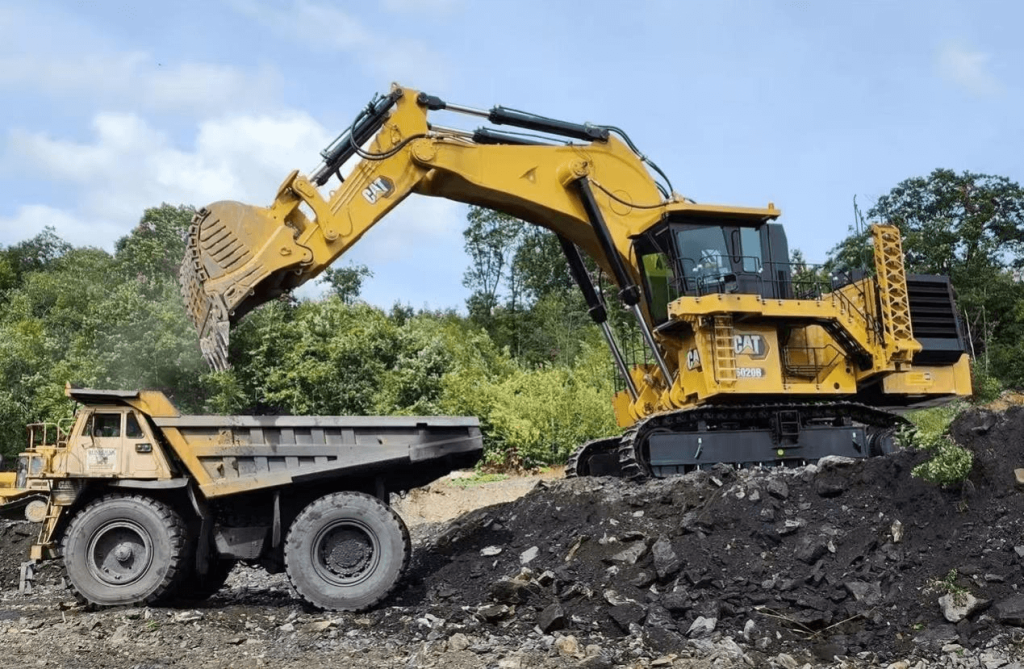
The difference between a “box” and a “tool” is 20 years of trial and error.
It most people buy an excavator bucket like they buy a grocery bag—looking for the biggest one. But in a high-intensity mine, that logic is the fastest way to kill your profit margins. As an OEM manufacturer with over 20 years of on-site mining attachment experience, we’ve seen the same selection mistakes repeat themselves across different continents.
Below is the internal checklist we actually use when reviewing bucket configurations for mining sites, shared here for owners, operators, and procurement teams.
Myth vs. Reality: Why Bigger Excavator Buckets Reduce Mining Efficiency
Myth: A 2.5m³ bucket always moves more rock than a 2.0m³ bucket.
Reality: If the material is high-density iron ore, the 2.5m³ bucket will cause the machine to “stall” or cycle slowly. A correctly sized 2.0m³ bucket will penetrate faster and complete 4 cycles in the time the larger bucket completes 3.
The “Bottom Line” Result: In high-density materials, a correctly spec’d smaller bucket has repeatedly delivered around 10–15% higher tonnage per shift, while also reducing fuel burn.
The 3-Step Selection Scorecard
Before you sign a purchase order, run your site through these three filters:
1. Material Density (The Weight Factor)
Don’t guess. Use the Specific Gravity of your rock.
Low Density (<1.6t/m³): Go wide. Use a high-volume bucket with standard side-cutters.
High Density (>2.2t/m³): Go narrow. You need a tapered design to reduce “drag” and maximize the pressure on each tooth.
2. The “Short-Arm” Secret (Geometry)
We often adjust the Tip Radius (the distance from the pin to the tooth tip) based on the machine’s arm length.
For Maximum Power: A shorter tip radius gives you more leverage. It’s like using a shorter crowbar to lift a heavier rock—it’s easier on the machine’s “muscles” (the hydraulics).
3. Taper: The “Easy Release” Design
If your bucket is a perfect square, the mud and rock will “vacuum” itself to the sides. Our 20-year design secret? The Triple Taper. The bucket opening is wider than the back in three different directions. This ensures the load falls out the moment you open the bucket, saving you 2 seconds every single pass.
Pro-Tip from the Factory Floor: “Dead Weight” is Your Enemy
In our international OEM projects, we focus on Strength-to-Weight Ratio.
Using regular steel to build a “strong” bucket usually means making it thick and heavy. But a heavy bucket is just “dead weight” that your engine has to lift thousands of times a day.
Our Approach: By using Hardox 450, we can keep the bucket shell thin (15mm instead of 25mm) while making it even tougher. This allows you to convert that saved weight into extra payload. In mining, saving 500kg of bucket weight means moving an extra 500kg of ore—for free—every single scoop.
Real-World Q&A (Field Insights)
“My bucket teeth are wearing out every 3 days. Is the steel bad?”
Not necessarily. It usually means the bucket shape is forcing the machine to “rub” the rock rather than “cut” it. We’ve found that switching to a Spade Nose (V-edge) design can extend tooth life by 30% because it initiates the crack in the rock face more efficiently.
“Why is my bucket cracking near the hinge?”
This is a classic sign of “stress concentration.” After 20 years, we’ve learned that welding extra plates actually makes the bucket too stiff, causing it to crack next to the reinforcement. A good mining bucket should be able to “flex” slightly under load.
The 20-Year Guarantee
At CPM we don’t just build buckets; we build production tools. Our 20-year history of serving international mining brands means we’ve already solved the problems you’re facing today.
FAQ: Mining Excavator Bucket Selection
Q1: How do I calculate the right bucket size for my excavator in mining operations?
At our factory, we always start with effective payload, not bucket volume.
Here is the rule we use internally:
Check the excavator’s maximum allowable payload from the OEM manual
Subtract the actual bucket weight (not the catalog weight)
The remaining number is your real usable payload
In high-density materials like granite or iron ore, an oversized bucket often exceeds this limit before it is even full. In our field tests, a correctly sized bucket improves penetration speed and reduces hydraulic strain, resulting in more tons moved per shift, even with a smaller nominal capacity.
Q2: Is Hardox 450 always the best material for mining excavator buckets?
Hardox 450 is not a marketing label for us — it is a design tool.
In most hard-rock mining applications, Hardox 450 offers the best balance between:
Wear resistance
Impact toughness
Strength-to-weight ratio
However, our engineers do not apply Hardox blindly. For example:
High-impact lip areas may require different thickness strategies
Some internal structural parts benefit more from controlled flexibility than extreme hardness
That is why every mining bucket we build is material-selected by zone, not by habit.
Q3: Why do excavator buckets crack near the hinge or ear plates?
In our 20 years of OEM manufacturing, hinge-area cracking is almost never caused by thin steel.
The real causes are:
Stress concentration from over-reinforcement
Poor weld geometry and sharp transitions
Excessive bucket dead weight amplifying cyclic loads
A mining bucket must be strong, but it must also be able to flex slightly under load. When a bucket is built like a rigid block, the stress has nowhere to go — so it cracks at the weakest point.
Q4: Can a lighter bucket really improve mining productivity?
Yes — and this is one of the most misunderstood concepts in mining operations.
From our production data, reducing bucket weight by 500 kg allows:
Higher effective payload per cycle
Faster swing and dump times
Lower fuel consumption per ton
In real mining conditions, this often translates to 10–15% higher hourly output, without changing the machine itself.
Is your current bucket working against you?
[Book a 15-minute Technical Consultation with our Lead Engineer]
Excavator Bucket
Auxerunt haec vulgi sordidioris audaciam, quod cum ingravesceret penuria commeatuum, famis et furoris inpulsu Eubuli cuiusdam inter suos clari domum ambitiosam ignibus subditis inflammavit