Solving Sticky Ore and Slow Bucket Discharge Without Increasing Bucket Weight
In a 24/7 open-pit copper mine in Zambia’s Copperbelt region, CPM supplied 12 custom mining buckets for 45–70 ton excavators operating in high-moisture, high-adhesion ore conditions. By optimizing bucket floor geometry and internal material flow—without increasing weight—average loading cycle time was reduced by 4 seconds. Under continuous operation, this improvement delivered an approximate 15% increase in overall production, with no additional stress on the machines.
Customer Case | African Copper Mine
How Custom Mining Buckets Increased Production by 15% in a Zambian Copper Mine
Location: Zambia · Copperbelt Region
Industry: Open-Pit Copper Mining
Excavator Class: 45–70 Ton
Solution: Custom Mining Buckets for High-Adhesion Ore
Result: 4 seconds faster cycle time, ~15% production increase
Project Background
This project was carried out at an open-pit copper mine located in Zambia’s Copperbelt region. The site operates 24 hours per day with a mixed fleet of 45–70 ton excavators, primarily loading blasted copper ore and overburden.
As the mine increased its production targets, management identified a growing bottleneck:
loading efficiency was limiting hauling capacity, even though the excavators themselves were operating within normal hydraulic and power parameters.
The Challenge
The mine was using standard OEM large-capacity mining buckets. On paper, the specifications were correct. In real operation, several issues appeared:
- High digging resistance during bucket penetration
- Sticky, high-moisture ore adhering to the bucket floor and side plates
- Incomplete dumping, requiring repeated shaking
- Extended cycle times per load
Key finding:
The issue was not bucket strength or thickness, but poor material flow and release inside the bucket.
Engineering Assessment
CPM engineers conducted an on-site evaluation together with the mine’s maintenance and production teams.
Material Characteristics:
- Blasted copper ore mixed with clay-rich overburden
- High moisture content, especially during the rainy season
- Strong adhesion to steel surfaces
- Tendency to compact inside the bucket
This is a common but underestimated condition in African copper mines.
A significant portion of the excavator’s breakout force was being consumed overcoming internal bucket friction, not cutting the rock face.
CPM Solution
Instead of increasing plate thickness or bucket weight, CPM focused on geometry, flow behavior, and controlled surface treatment.
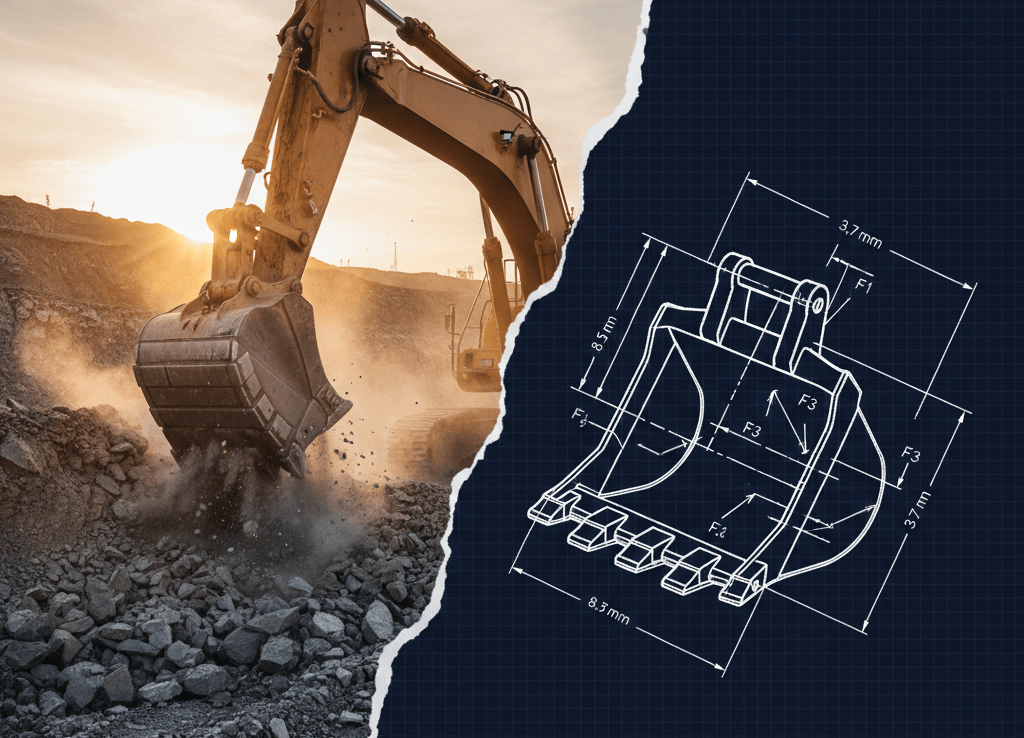
1. Optimized Bucket Floor Radius
The original bucket had a relatively flat floor, typical of general mining designs.
CPM redesigned the floor with a larger, continuous curvature, eliminating dead zones where sticky material accumulated and improving material rolling during both loading and dumping.
2. Internal Volume Redistribution
Without changing nominal bucket capacity, CPM adjusted how volume was distributed internally:
- Reduced ineffective rear volume
- Increased usable loading volume near the bucket mouth
This resulted in:
- Easier penetration
- More consistent fill factor
- Reduced resistance during hoist and swing
Nano Anti-Adhesion Coating (Supportive Measure)
After structural optimization, a nano anti-adhesion coating was applied to the internal surfaces.
Important clarification:
- The coating does not make material “non-stick”
- Its role is to reduce adhesion strength, not eliminate it
- Structural design remained the primary performance driver
Implementation
- 12 custom buckets installed across three excavators
- Fully compatible with existing linkages and tooth systems
- No additional machine downtime beyond scheduled maintenance
- No change required to operator habits or procedures
Measured Results
After 30 days of continuous operation, the mine’s engineering team confirmed:
- Average cycle time reduced by approximately 4 seconds
- Improved and more consistent bucket fill
- Significantly reduced need for shaking during dumping
Why 4 Seconds Matters:
- ~500–600 cycles per excavator per day
- 24-hour continuous operation
- Multiple machines working in parallel
★Result:
An overall production increase of approximately 15%, with no additional stress on the machines.
Additional Observations
Although not the primary goal, the mine also reported:
- Reduced operator fatigue
- Lower fuel consumption per ton moved
- Smoother hydraulic load behavior
- More predictable maintenance intervals
These effects typically follow once internal bucket resistance is properly controlled.
Project Summary
In high-adhesion, high-moisture mining conditions, productivity losses are rarely caused by insufficient steel thickness.
They are usually caused by poor material flow inside the bucket.
This Zambian copper mine case confirms CPM’s long-standing engineering principle:
A mining bucket should be designed to move material efficiently, not just survive impact.
About CPM
With over 20 years of OEM manufacturing experience, CPM designs and builds mining buckets based on real operating conditions, not catalog assumptions.
We work from material properties, duty cycles, and machine geometry to deliver solutions that improve tons-per-hour and reduce cost-per-ton.
Contact CPM to receive a site-specific bucket evaluation for your operation.